

IN-PERSON THERAPY IN AUSTIN + VIRTUAL THROUGHOUT TEXAS
You can be doing well and still want something to change.
Thoughtful, relational, and holistic therapy for those navigating anxiety, perfectionism, relationships, identity, and meaningful life transitions.

Being capable doesn’t mean everything feels manageable.
You may be thoughtful, capable, and accustomed to figuring things out. You may hold yourself to high standards, spend a lot of time thinking about what you should be doing, or find yourself trying to meet the expectations of the people around you. From the outside, you might even seem like you’re doing pretty well—even when things feel much more complicated on the inside.
Being capable doesn’t make you immune to anxiety, exhaustion, uncertainty, loss, relationship difficulties, or periods when you’re questioning who you are, what matters to you, or what comes next.
Maybe you’re exhausted from trying to get everything right. You’re navigating changing relationships or expectations. You’re figuring out who you are apart from who other people expect you to be. Something in your life or health has changed. Or perhaps you’ve simply become aware of patterns in the way you think, feel, cope, or relate to others that you understand—or desperately wish you understood—but haven’t quite figured out how to change.
Therapy can be a place to understand what’s happening, how you got here, and what you want to do with what comes next.

Therapy for the whole you.
What we experience emotionally doesn’t happen in isolation.
I approach therapy through a holistic biopsychosocial lens, which means we’ll consider the many parts of your life that influence one another—your biology and health, emotions and patterns of thinking, relationships and developmental experiences, identity and values, environment, culture, responsibilities, and the larger systems and circumstances in which you live.
Many people come to me asking some version of, “How do I stop feeling this way?” “How do I get through this?” or “Why can’t I change?” While skills and psychoeducation can certainly be valuable parts of effective therapy, I’ve found that often the most helpful place to begin is with curiosity.
We can get curious about the ways you’ve learned to cope, how those patterns developed, what purpose they may have served, and how they make sense within the broader context of your life. From there, we can explore what’s still serving you, what may no longer be working, and what other possibilities might help you move beyond simply getting through or managing toward a life that feels more sustainable, intentional, and aligned with what matters to you.
I’ve found that when we understand the whole picture, we have more possibilities for meaningful change.
Areas of Focus
The people who come to work with me are often navigating concerns related to:
Anxiety, Overthinking & Perfectionism
When your mind rarely stops, expectations stay high, and it’s difficult to feel like you’ve done enough.
Relationships, Boundaries & Communication
Understanding relational patterns, communicating more directly, setting boundaries, building assertiveness, and staying connected without losing yourself.
High Achievement, Stress & Burnout
When being capable, productive, responsible, or the person everyone relies on has started to come at a cost.
Pregnancy, Postpartum & Parenthood
Support for emotional, relational, and identity shifts during pregnancy, postpartum, parenting, and changing family roles.
Identity, Values & Meaning
Exploring who you are beyond your roles, responsibilities, accomplishments, or other people’s expectations—and what matters to you.
Body Image, Eating & Relationship With Your Body
Weight-inclusive support for body image, disordered eating, eating disorder recovery, and changing relationships with food, exercise, health, and your body.
Life, Career & Health Transitions
Navigating changes in career, relationships, family roles, identity, health, or ability—and adapting when life looks different than you expected.
Emotional Sensitivity, Overwhelm & Coping
Understanding emotional sensitivity, overstimulation, and overwhelm—and developing ways of coping that honor both your needs and the realities of your life.

Meet Chelsea
Chelsea Fielder-Jenks, LPC-S, CEDS-C, PMH-C
Founder • Therapist • Clinical Supervisor & Consultant
Over the past 15 years, I’ve had the privilege of working with people across the mental health care continuum—from outpatient therapy to intensive treatment and inpatient settings. That experience has allowed me to sit with people through some of their most vulnerable and complicated moments, and to hear the stories behind concerns that can look very different on the surface. Across those experiences, I’ve come to understand that people are generally doing the best they can with what they have available to them—and that the ways we learn to cope often make much more sense when we understand the whole person and the context in which those patterns developed.
At my core, I’m a relational therapist who works from a holistic biopsychosocial lens. My background in health psychology, along with years of clinical practice and advanced training, has deepened the way I understand the interplay between our biology and health, psychology and emotions, relationships, development, environment, culture, and lived experiences. I bring that perspective into therapy by getting curious about the whole person—not simply the concern that brought someone through the door.
I integrate evidence-based approaches—primarily DBT and CBT—with depth-oriented therapy to help clients better understand themselves, shift longstanding patterns, and make meaningful changes in their lives and relationships. My style is warm, compassionate, direct, curious, and collaborative—with humor often finding its way into the room.
Over the course of my career, I’ve developed particular depth in anxiety and mood concerns, eating disorders and body image, perinatal mental health, substance use and harm reduction, DBT, trauma, and complex co-occurring concerns. I’m a Licensed Professional Counselor-Supervisor (LPC-S), Certified Eating Disorders Specialist and Consultant (CEDS-C), and certified in Perinatal Mental Health (PMH-C).

For Therapists & Mental Health Professionals
Thoughtful support for the people doing thoughtful work.
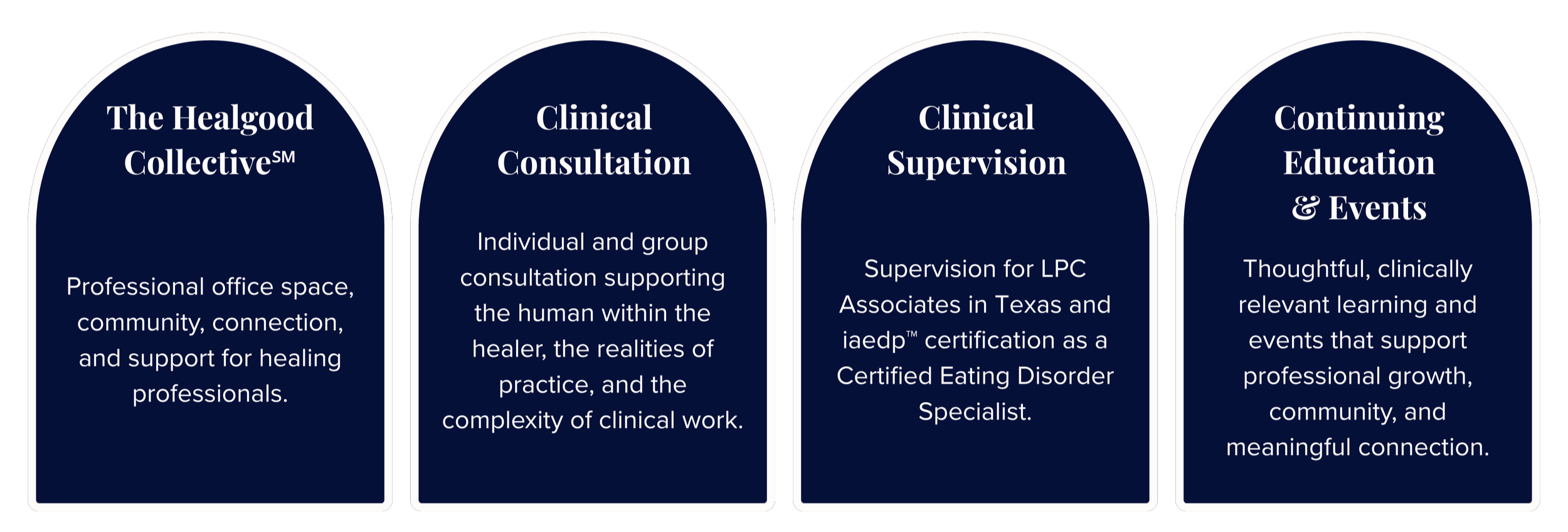
Alongside my therapy practice, I provide professional community, clinical consultation, supervision, and continuing education for mental health professionals.
Whether you’re navigating a complex case, developing your clinical identity, pursuing advanced credentials, growing into the role of supervisor, or simply looking for meaningful professional connection, you don’t have to do that work in isolation.




Est. Since 2017
In-Person + Virtual
Healgood is located in Central Northwest Austin.
Can’t make it into the office? No worries – if you live in Texas, we can meet virtually through telehealth.
• Acceptance & Change • Compassion & Accountability • Who you’ve been & Who you’re becoming
• Acceptance & Change • Compassion & Accountability • Who you’ve been & Who you’re becoming
A place to begin.
Effective therapy begins with a strong therapeutic relationship and finding a therapist who feels like a good fit for you. That means more than finding someone who works with the concerns bringing you to therapy. Their interpersonal style, clinical approach, and experience should also align with what you're looking for and help create the kind of relationship in which meaningful work can happen.
That's why I offer a complimentary 30-minute consultation before we begin. It's a chance for you to share a little about what brings you to therapy, what you're hoping for from the process, and what working together might look like. You'll also have plenty of opportunity to ask questions, get a feel for how I interact with you, and decide whether my style and approach feel like a good fit.