
Holding Your Body with Compassion in a World of Diet Culture
Contributed by Emily Carr, LPC Associate — Supervised by Chelsea Fielder-Jenks, LPC-S, CEDS-C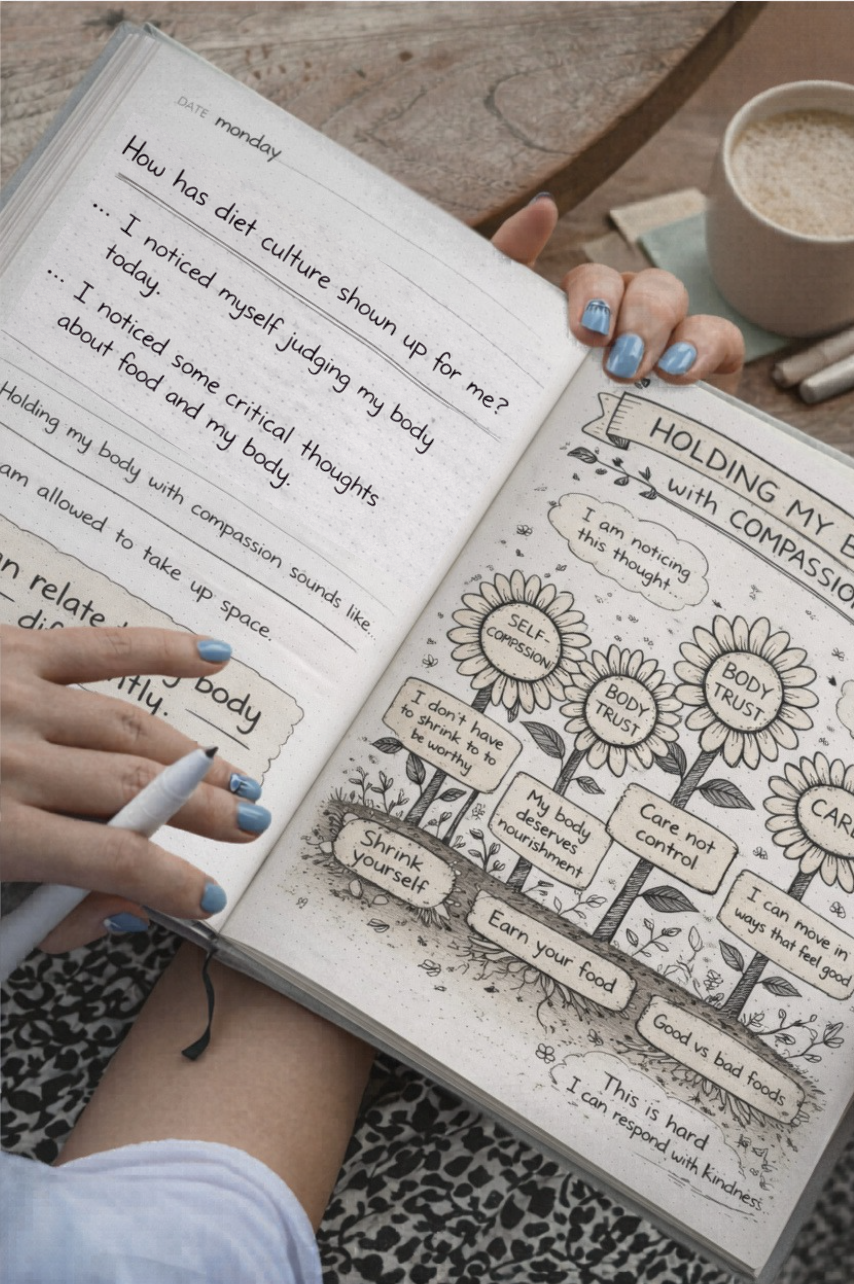
Image created by Chelsea Fielder-Jenks, 2026.Image Description: Open journal with handwritten reflections on diet culture and body image on one page, and a hand-drawn garden of self-compassion and anti-diet affirmations on the other, held in a person’s hands in a calm, cozy setting.
We live in a Westernized society plagued by diet culture, which Christy Harrison - Author of Anti-Diet: Reclaim Your Time, Money, Well-Being, and Happiness through Intuitive Eating - defines as “a system of beliefs that equates thinness, muscularity, and particular body shapes with health and moral virtue” (Harrison, 2019, p. 7). With its emphasis on weight loss, placing moral value on food, and condemning those who do not align with this idealized image, diet culture has created lasting consequences on the individual and systemic level.
Now begs the question: How can we feel comfortable taking up space in a society that is constantly telling us to shrink ourselves?
While diet culture may tell us to try that newest diet or weight loss “hack,” to force our bodies into rigid exercise that feels more like punishment than pleasure, or that we simply aren’t good enough, self-compassion tells us something much different.
Self-compassion is described as “how we relate to ourselves in instances of perceived failure, inadequacy, or personal suffering” (Neff, 2023). Doctor Kristen Neff, a lead researcher on the construct, conceptualizes self-compassion as organized into three domains:
Self-Kindness v. Self-Judgment: How people emotionally respond to suffering
Common Humanity v. Isolation: How people cognitively understand their circumstances
Mindfulness v. Over-identification: How people pay attention to suffering
→ For a deeper dive into self-compassion, check out our previous blog post titled Changing Your Life with Self-Compassion here!
Self-kindness involves showing ourselves the same kindness, support, warmth, understanding, and validation that we show to people around us, regardless of perceived flaws or imperfections.
Self-kindness can look like:
Giving yourself unconditional permission to eat
Yes, even if you did not exercise today
Yes, even if you recently went up a size in jeans
Yes, even if you failed a math test or missed a deadline at work
Yes, even if you got into an argument with your family member, friend, or partner
Considering personal satisfaction, culture, and well-being when making food choices
Incorporating movement into your routine that is focused on enjoyment or pleasure
Respecting your body, regardless of its shape or size
Your worth, character, intelligence, and capacity to love and be loved are not dependent or contingent on your appearance, body shape, or size
The good news is, we are in this together …
Common humanity involves an understanding that hardship is a part of being human, an experience that is shared.
Common Humanity can look like:
Acknowledging that diet culture has resulted in a widespread societal impact
You are not alone, even when circumstances feel especially isolating
Other people also struggle to be kind to their bodies due to internalized beliefs and the messaging of diet culture
With this, we also learn to notice …
Mindfulness involves observing, describing, and participating in present moment experiences without judgment.
Mindfulness can look like:
Observing your body’s hunger and fullness cues without judgment
Example: “I am noticing my stomach growling. This is my body’s way of telling me I need nourishment.”
Example: “I am feeling comfortably full. My body has the nourishment it needs right now, and I will pause here.”
Observing and describing your present thoughts and feelings without judgment
Example: “I am noticing some thoughts about my body, and I do not have to accept them as fact.”
Example: “I am noticing feelings of frustration towards my body, and I can still treat myself with care and compassion.”
Self-compassion certainly offers a helpful framework that encourages us to treat our bodies with kindness and respect. However, I invite you to continue asking yourself - How is diet culture showing up for me?
If you’re looking for support in cultivating body compassion or navigating your relationship with food and movement, here are a few places to begin:
Connect with a weight-inclusive provider: It can be helpful to look for clinicians (therapists, healthcare providers) who also embrace weight-inclusive, anti-diet approaches including Intuitive Eating and Health at Every Size® principles.
Additional resources:
Books
Anti-Diet: Reclaim Your Time, Money, Well-Being, and Happiness Through Intuitive Eating
Christy Harrison challenges diet culture and advocates for intuitive eating, providing a guide to reclaiming well-being and happiness by fostering a more mindful and intuitive approach to food.
Linda Bacon and Lucy Aphramor challenge conventional notions about weight and health, offering a perspective that emphasizes respect for diverse bodies and promotes well-being.
Evelyn Tribole and Elyse Resch outline the principles of intuitive eating, promoting a mindful and intuitive approach to nourishing the body and fostering a healthy relationship with food.
Podcasts
Food Psych - Christy Harrison, MPH, RD
Body Kindness - Rebecca Scritchfield, RDN
Maintenance Phase - Aubrey Gordon & Michael Hobbes
→ View more resources in Healgood’s Library
References
Association for Size Diversity and Health. (n.d.). Health at every size® (HAES®) approach. https://asdah.org/health-at-every-size-haes-approach/
Harrison, C. (2019). Anti-diet: Reclaim your time, money, well-being, and happiness through intuitive eating. Little, Brown Spark.
Neff, K. D. (2023). Self-compassion: Theory, method, research, and intervention. Annual Review of Psychology, 74, 193-218.
The Original Intuitive Eating Pros. (n.d.). Intuitive eating. Retrieved April 9, 2026, from https://www.intuitiveeating.org/

~ Emily Carr, LPC Associate
Associate Therapist, Supervised by Chelsea Fielder-Jenks, LPC-S, CEDS-C
Emily’s work is grounded in HAES®-aligned, trauma-informed care, and she is especially passionate about supporting clients in healing their relationship with food, body, and self through compassion and curiosity.