 Image 1 of 1
The Therapist's Tarot Journal: Independent-Study Continuing Education
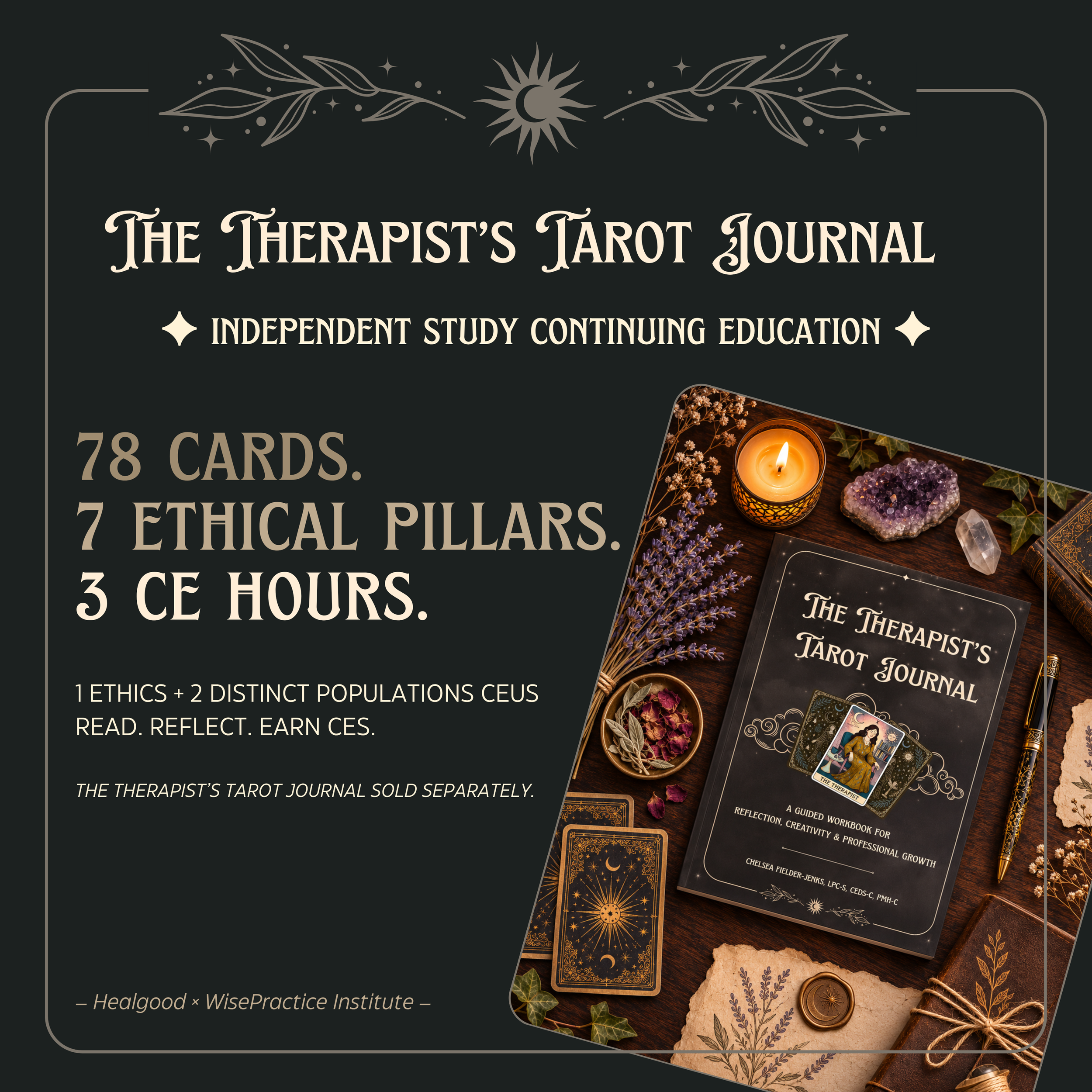
Earn 3 CE hours (1 Ethics + 2 Distinct Populations) for your reading and reflection.
Have you been working through The Therapist’s Tarot Journal? If you’re a licensed mental health professional, you can earn continuing education credit for the learning you’ve already done in the workbook.
Written by a licensed therapist for fellow clinicians, The Therapist’s Tarot Journal explores tarot both as a personal reflective practice and as a symbolic language your clients may bring into the room. This self-paced offering lets you show and document what you’ve learned: tarot’s history and symbolism, what the research and professional ethics codes say, and how to meet clients’ beliefs with cultural humility.
You don’t need any extra reading. The workbook is the course material. The CE process is a short knowledge assessment, a guided reflection, and a course evaluation.
Presented by Healgood Holistic Counseling Center in collaboration with WisePractice Institute.
CE Offering Details
Continuing Education: 3 CE hours
Credit Categories: 1 hour Ethics + 2 hours Distinct Populations
Format: Independent study, self-paced, with an online assessment and evaluation
Cost: $29
Required Material: The Therapist’s Tarot Journal, full paperback edition (purchased separately)
Author: Chelsea Fielder-Jenks, MA, LPC-S, CEDS-C, PMH-C
CE Provider: Healgood Holistic Counseling Center
Publisher: WisePractice Institute
Important: The Workbook Is Not Included
Your CE purchase covers the CE assessment, evaluation, and certificate only. It does not include a copy of The Therapist’s Tarot Journal.
You’ll need the full paperback edition to complete the required reading and reflection. Note: The shorter workshop edition used at the Therapist’s Tarot Social Workshop does not include all the required content.
Already have your copy? You can register whenever you’re ready.
Need the workbook? Purchase The Therapist’s Tarot Journal on Amazon →
Disclosure: Chelsea Fielder-Jenks is the author of The Therapist’s Tarot Journal and receives royalties from its sale. The book is published by WisePractice Institute, which she founded. The Amazon link on this page is also an affiliate link. As an Amazon Associate, we earn from qualifying purchases.
About the Workbook
Grounded in history, research, and professional ethics, The Therapist’s Tarot Journal invites you to meet the cards with curiosity, creativity, and care, as a mirror for reflection rather than a crystal ball. It’s divided into three parts, and each one builds on the one before it.
Part One | Foundations
Traces tarot’s surprising journey from Renaissance card game to modern reflective tool, separating documented history from legend. It introduces the structure and language of all 78 cards, with reference sheets for the Major and Minor Arcana. It then covers how readings and spreads work and presents a four-step reflective framework for approaching the cards with curiosity rather than certainty. Reading examples show the framework in practice.
Part Two | Tarot in Therapy
Turns to what happens when tarot shows up in clinical work. It reviews what the research and four major professional ethics codes say about tarot in therapy, including the possibilities and limits of tarot as a reflective tool. It then offers an ethical framework built on seven pillars of ethical practice and looks at who brings tarot to therapy and why. Clinical considerations, case applications, and reflection prompts support thoughtful, client-centered decision-making grounded in cultural and spiritual humility.
Part Three | Reflective Practice
This is where the workbook becomes yours, with nearly 100 pages of spreads, journal prompts, and creative exercises made for therapists. It includes a Daily Draw Diary; guided pages for classic spreads, from a single-card draw to the Celtic Cross; and spreads designed for clinicians, such as The Therapist Within, What Am I Carrying?, and The Compassionate Clinician. There are also open journal pages and a closing reflection on what you’ll carry forward.
Throughout, readers are encouraged to approach tarot with discernment. That means respecting the meaning tarot may hold for a client while keeping reflective experiences distinct from established psychotherapy interventions. The workbook also includes a glossary and full APA references.
Learning Objectives
By completing this offering, participants will be able to:
Describe how tarot evolved from a Renaissance card game into a tool for divination and, later, reflection, and distinguish its documented history from its legends, as context for understanding the spiritual and cultural practices clients may bring to therapy.
Explain how the 78-card deck is organized, including the traditional meanings of the suits, numbers, and court cards, so clinicians can understand the symbolic language clients use when discussing tarot.
Summarize what current research does and doesn’t tell us about tarot as a reflective tool, and how to represent that evidence accurately to clients.
Identify the ethical considerations that apply when tarot comes up in clinical work, including competence, scope of practice, informed consent, clinical rationale, and the relevant provisions of your profession’s ethics code.
Explain how cultural, religious, spiritual, and individual differences shape a client’s relationship with tarot, and how cultural humility and client autonomy guide your response.
Evaluate tarot-related clinical scenarios through a biopsychosocial, trauma-informed lens, distinguishing client-led meaning-making from therapist-imposed interpretation.
Apply ethical principles about boundaries, multiple relationships, and role clarity to situations both inside and outside the therapy room.
Use a four-step reflective framework and the journal spreads in Part Three to explore tarot for your own personal and professional growth.
How It Works
Step 1 | Read & Reflect
Complete the required reading and reflection activities in The Therapist’s Tarot Journal at your own pace: the Introduction, Part One, Part Two, and at least one spread or exercise from Part Three. If you’ve already finished the workbook, you don’t need to repeat it. You’ll just confirm completion and report your time.
Step 2 | Register for CE Credit
Purchase this independent-study CE offering. After checkout, you’ll receive an email with a PDF of instructions and a link to the online form.
Step 3 | Demonstrate Your Learning
The online form includes your attestation of completion, your reported time, a short knowledge check, and a guided reflection. If you miss a question on the knowledge check, you’ll be pointed back to the relevant section of the workbook to review and try again.
Step 4 | Complete Your Evaluation & Receive Your Certificate
Submit the course evaluation, then download your CE certificate and keep it for your professional records.
CE Requirements & Eligibility
Who It's For & CE Eligibility
This offering is designed for licensed mental health professionals, including counselors, marriage and family therapists, social workers, and other behavioral health professionals.
Texas-Licensed Clinicians: This is an organized, provider-issued continuing education offering, not informal self-study under Texas Behavioral Health Executive Council (BHEC) rules. Although completed independently, it is not subject to BHEC's one-hour informal self-study limit.
The offering was developed and is presented by Chelsea Fielder-Jenks, MA, LPC-S, CEDS-C, PMH-C, a Texas Licensed Professional Counselor-Supervisor who meets the qualifying provider criteria under BHEC's 50% CE rule for Texas LPCs, LMFTs, LMSWs, and LCSWs.
CE Credit: 3 Hours
1 CE Hour — Ethics
2 CE Hours — Distinct Populations
Clinicians Licensed Outside Texas: You are welcome to participate. However, CE requirements and provider qualifications vary by jurisdiction. Please verify acceptance of this offering and its credit categories with your licensing board before purchasing.
Earning Credit
To receive the full 2 CE hours, participants must:
Attest to completing all required workbook reading and reflection activities.
Report at least 3 hours of qualifying instructional time.
Answer every knowledge-check question correctly (you can review and try again as needed).
Complete the guided reflection and course evaluation.
Purchasing the offering or reading the workbook alone does not earn CE credit. Partial credit is not available.
Important Considerations
Attended the Therapist’s Tarot Social? This offering overlaps with content from the Therapist’s Tarot Social workshop. If you’ve already received CE credit for the workshop, check with your licensing board before claiming credit again for the same material.
CE Acceptance & Responsibility: Texas BHEC does not preapprove individual CE courses or providers. Participants are responsible for confirming that the offering, provider qualifications, credit hours, and Ethics and Distinct Populations designations satisfy their applicable licensing requirements.
A Note on Clinical Scope
This workbook is an introduction to tarot and a chance to think critically about how it might relate to psychological reflection and clinical practice.
It is not a certification or specialized clinical training, and it does not endorse tarot as an evidence-based psychotherapy intervention. Completing the workbook or the CE assessment does not establish competence to use tarot in psychotherapy.
Policies
Refunds: Due to immediate access to digital CE materials, all purchases are final and nonrefundable, except where required by law. Please review the course details, eligibility requirements, and policies closely before purchasing.
Accessibility & Accommodations: We are committed to making our continuing education offerings accessible. If you need a reasonable accommodation to complete the assessment or evaluation, please contact us so we can discuss your needs.
Questions or Concerns: For assistance with accessing course materials, completing the CE requirements, or receiving your certificate, please contact us.
Ready to Receive CE Credit?
If you’ve finished the workbook and want to document your learning toward your CE requirements, register below.
After checkout, your CE instructions and assessment link will arrive by email.
Healgood Holistic Counseling Center, in collaboration with WisePractice Institute
Earn 3 CE hours (1 Ethics + 2 Distinct Populations) for your reading and reflection.
Have you been working through The Therapist’s Tarot Journal? If you’re a licensed mental health professional, you can earn continuing education credit for the learning you’ve already done in the workbook.
Written by a licensed therapist for fellow clinicians, The Therapist’s Tarot Journal explores tarot both as a personal reflective practice and as a symbolic language your clients may bring into the room. This self-paced offering lets you show and document what you’ve learned: tarot’s history and symbolism, what the research and professional ethics codes say, and how to meet clients’ beliefs with cultural humility.
You don’t need any extra reading. The workbook is the course material. The CE process is a short knowledge assessment, a guided reflection, and a course evaluation.
Presented by Healgood Holistic Counseling Center in collaboration with WisePractice Institute.
CE Offering Details
Continuing Education: 3 CE hours
Credit Categories: 1 hour Ethics + 2 hours Distinct Populations
Format: Independent study, self-paced, with an online assessment and evaluation
Cost: $29
Required Material: The Therapist’s Tarot Journal, full paperback edition (purchased separately)
Author: Chelsea Fielder-Jenks, MA, LPC-S, CEDS-C, PMH-C
CE Provider: Healgood Holistic Counseling Center
Publisher: WisePractice Institute
Important: The Workbook Is Not Included
Your CE purchase covers the CE assessment, evaluation, and certificate only. It does not include a copy of The Therapist’s Tarot Journal.
You’ll need the full paperback edition to complete the required reading and reflection. Note: The shorter workshop edition used at the Therapist’s Tarot Social Workshop does not include all the required content.
Already have your copy? You can register whenever you’re ready.
Need the workbook? Purchase The Therapist’s Tarot Journal on Amazon →
Disclosure: Chelsea Fielder-Jenks is the author of The Therapist’s Tarot Journal and receives royalties from its sale. The book is published by WisePractice Institute, which she founded. The Amazon link on this page is also an affiliate link. As an Amazon Associate, we earn from qualifying purchases.
About the Workbook
Grounded in history, research, and professional ethics, The Therapist’s Tarot Journal invites you to meet the cards with curiosity, creativity, and care, as a mirror for reflection rather than a crystal ball. It’s divided into three parts, and each one builds on the one before it.
Part One | Foundations
Traces tarot’s surprising journey from Renaissance card game to modern reflective tool, separating documented history from legend. It introduces the structure and language of all 78 cards, with reference sheets for the Major and Minor Arcana. It then covers how readings and spreads work and presents a four-step reflective framework for approaching the cards with curiosity rather than certainty. Reading examples show the framework in practice.
Part Two | Tarot in Therapy
Turns to what happens when tarot shows up in clinical work. It reviews what the research and four major professional ethics codes say about tarot in therapy, including the possibilities and limits of tarot as a reflective tool. It then offers an ethical framework built on seven pillars of ethical practice and looks at who brings tarot to therapy and why. Clinical considerations, case applications, and reflection prompts support thoughtful, client-centered decision-making grounded in cultural and spiritual humility.
Part Three | Reflective Practice
This is where the workbook becomes yours, with nearly 100 pages of spreads, journal prompts, and creative exercises made for therapists. It includes a Daily Draw Diary; guided pages for classic spreads, from a single-card draw to the Celtic Cross; and spreads designed for clinicians, such as The Therapist Within, What Am I Carrying?, and The Compassionate Clinician. There are also open journal pages and a closing reflection on what you’ll carry forward.
Throughout, readers are encouraged to approach tarot with discernment. That means respecting the meaning tarot may hold for a client while keeping reflective experiences distinct from established psychotherapy interventions. The workbook also includes a glossary and full APA references.
Learning Objectives
By completing this offering, participants will be able to:
Describe how tarot evolved from a Renaissance card game into a tool for divination and, later, reflection, and distinguish its documented history from its legends, as context for understanding the spiritual and cultural practices clients may bring to therapy.
Explain how the 78-card deck is organized, including the traditional meanings of the suits, numbers, and court cards, so clinicians can understand the symbolic language clients use when discussing tarot.
Summarize what current research does and doesn’t tell us about tarot as a reflective tool, and how to represent that evidence accurately to clients.
Identify the ethical considerations that apply when tarot comes up in clinical work, including competence, scope of practice, informed consent, clinical rationale, and the relevant provisions of your profession’s ethics code.
Explain how cultural, religious, spiritual, and individual differences shape a client’s relationship with tarot, and how cultural humility and client autonomy guide your response.
Evaluate tarot-related clinical scenarios through a biopsychosocial, trauma-informed lens, distinguishing client-led meaning-making from therapist-imposed interpretation.
Apply ethical principles about boundaries, multiple relationships, and role clarity to situations both inside and outside the therapy room.
Use a four-step reflective framework and the journal spreads in Part Three to explore tarot for your own personal and professional growth.
How It Works
Step 1 | Read & Reflect
Complete the required reading and reflection activities in The Therapist’s Tarot Journal at your own pace: the Introduction, Part One, Part Two, and at least one spread or exercise from Part Three. If you’ve already finished the workbook, you don’t need to repeat it. You’ll just confirm completion and report your time.
Step 2 | Register for CE Credit
Purchase this independent-study CE offering. After checkout, you’ll receive an email with a PDF of instructions and a link to the online form.
Step 3 | Demonstrate Your Learning
The online form includes your attestation of completion, your reported time, a short knowledge check, and a guided reflection. If you miss a question on the knowledge check, you’ll be pointed back to the relevant section of the workbook to review and try again.
Step 4 | Complete Your Evaluation & Receive Your Certificate
Submit the course evaluation, then download your CE certificate and keep it for your professional records.
CE Requirements & Eligibility
Who It's For & CE Eligibility
This offering is designed for licensed mental health professionals, including counselors, marriage and family therapists, social workers, and other behavioral health professionals.
Texas-Licensed Clinicians: This is an organized, provider-issued continuing education offering, not informal self-study under Texas Behavioral Health Executive Council (BHEC) rules. Although completed independently, it is not subject to BHEC's one-hour informal self-study limit.
The offering was developed and is presented by Chelsea Fielder-Jenks, MA, LPC-S, CEDS-C, PMH-C, a Texas Licensed Professional Counselor-Supervisor who meets the qualifying provider criteria under BHEC's 50% CE rule for Texas LPCs, LMFTs, LMSWs, and LCSWs.
CE Credit: 3 Hours
1 CE Hour — Ethics
2 CE Hours — Distinct Populations
Clinicians Licensed Outside Texas: You are welcome to participate. However, CE requirements and provider qualifications vary by jurisdiction. Please verify acceptance of this offering and its credit categories with your licensing board before purchasing.
Earning Credit
To receive the full 2 CE hours, participants must:
Attest to completing all required workbook reading and reflection activities.
Report at least 3 hours of qualifying instructional time.
Answer every knowledge-check question correctly (you can review and try again as needed).
Complete the guided reflection and course evaluation.
Purchasing the offering or reading the workbook alone does not earn CE credit. Partial credit is not available.
Important Considerations
Attended the Therapist’s Tarot Social? This offering overlaps with content from the Therapist’s Tarot Social workshop. If you’ve already received CE credit for the workshop, check with your licensing board before claiming credit again for the same material.
CE Acceptance & Responsibility: Texas BHEC does not preapprove individual CE courses or providers. Participants are responsible for confirming that the offering, provider qualifications, credit hours, and Ethics and Distinct Populations designations satisfy their applicable licensing requirements.
A Note on Clinical Scope
This workbook is an introduction to tarot and a chance to think critically about how it might relate to psychological reflection and clinical practice.
It is not a certification or specialized clinical training, and it does not endorse tarot as an evidence-based psychotherapy intervention. Completing the workbook or the CE assessment does not establish competence to use tarot in psychotherapy.
Policies
Refunds: Due to immediate access to digital CE materials, all purchases are final and nonrefundable, except where required by law. Please review the course details, eligibility requirements, and policies closely before purchasing.
Accessibility & Accommodations: We are committed to making our continuing education offerings accessible. If you need a reasonable accommodation to complete the assessment or evaluation, please contact us so we can discuss your needs.
Questions or Concerns: For assistance with accessing course materials, completing the CE requirements, or receiving your certificate, please contact us.
Ready to Receive CE Credit?
If you’ve finished the workbook and want to document your learning toward your CE requirements, register below.
After checkout, your CE instructions and assessment link will arrive by email.
Healgood Holistic Counseling Center, in collaboration with WisePractice Institute