
Why Community Is a Clinical Intervention for Therapists
by Chelsea Fielder-Jenks, LPC-S, CEDS-C, PMH-C
Therapists are trained to notice patterns, attune to nervous systems, and hold space for complexity — but many of us are quietly practicing in isolation.
We sit with clients’ pain, manage risk, document care, and make dozens of emotionally charged decisions every day. Then we often leave our offices and carry all of that alone.
At Healgood, we don’t see that as neutral. We see it as a clinical risk factor — for clinicians and for the people they serve.
Because isolation doesn’t just affect therapists. It affects the quality, ethics, and sustainability of care.
Burnout isn’t just about workload. It’s about being alone with it.

Burnout isn’t a personal failure — it’s what happens when care outpaces support.
You don’t have to do this alone. Healgood Collective is a place for clinicians to be human, together.
Research on clinician well-being is remarkably consistent: burnout is not simply the result of too many clients or too much paperwork. It’s deeply tied to lack of connection, lack of support, and the absence of meaningful professional community.
A review of the mental health self-care literature found that peer support, consultation, and collegial connection are among the strongest protective factors against burnout and emotional exhaustion (Posluns & Gall, 2020). When therapists don’t have places to think out loud, reflect, and be supported by other clinicians, emotional strain accumulates quietly — and often invisibly.
Barlow and Phelan (2007) found that peer collaboration functions as a form of emotional regulation and professional containment, helping counselors metabolize the relational intensity of their work. In other words, talking with other therapists isn’t just helpful — it changes how stress is processed in the nervous system.
Most of us feel this intuitively. When you finally get to say, “This case is hard,” to someone who truly understands, something shifts.
Community is part of ethical practice
Therapists are expected to practice with clarity, attunement, and sound judgment. But those capacities don’t live in a vacuum.
Barnett and Cooper (2009) argue that ethical, effective clinical work depends on what they call a “culture of self-care” — one that includes ongoing peer support, consultation, and professional community. When clinicians are isolated, they are more vulnerable to fatigue, cognitive narrowing, and emotional overload — all of which increase the risk of ethical drift.
Community acts as a form of clinical containment. It gives therapists places to bring uncertainty, countertransference, grief, and doubt. It offers mirrors, perspective, and reality checks. It helps us stay grounded enough to think clearly and respond rather than react.
That’s not indulgent. It’s responsible.
Why Healgood centers connection, not just caseloads
Healgood was built on the belief that clinicians deserve more than office space and scheduling software. We deserve to be known, supported, and in relationship with other thoughtful professionals.
That’s why the Healgood Collective exists — not just as a place to work, but as a place to belong.
We intentionally offer multiple ways to stay connected and resourced, including:
Reflective spaces like our First Fridays Book Club and Monday Mindful Moments
Ongoing consultation groups
Creative, nervous-system-friendly community events
Shared physical space that invites real, human connection
These aren’t add-ons. They’re part of how we support therapists to remain present, ethical, and alive in their work.
The literature backs this up. Therapists who engage in consistent peer support and reflective practice report lower burnout, greater job satisfaction, and a stronger sense of professional identity (Posluns & Gall, 2020; Barlow & Phelan, 2007).
You don’t have to do this alone
Many therapists were taught to be independent, self-sufficient, and quietly resilient. But that model comes at a cost.
Connection doesn’t make you weaker. It makes you steadier.
When clinicians are supported, clients receive better care. When therapists have community, they can keep showing up with curiosity, compassion, and integrity over time.
That’s the heart of what we’re building at Healgood — a practice and a collective that treats community not as a perk, but as a core part of healing.

—Join Us—
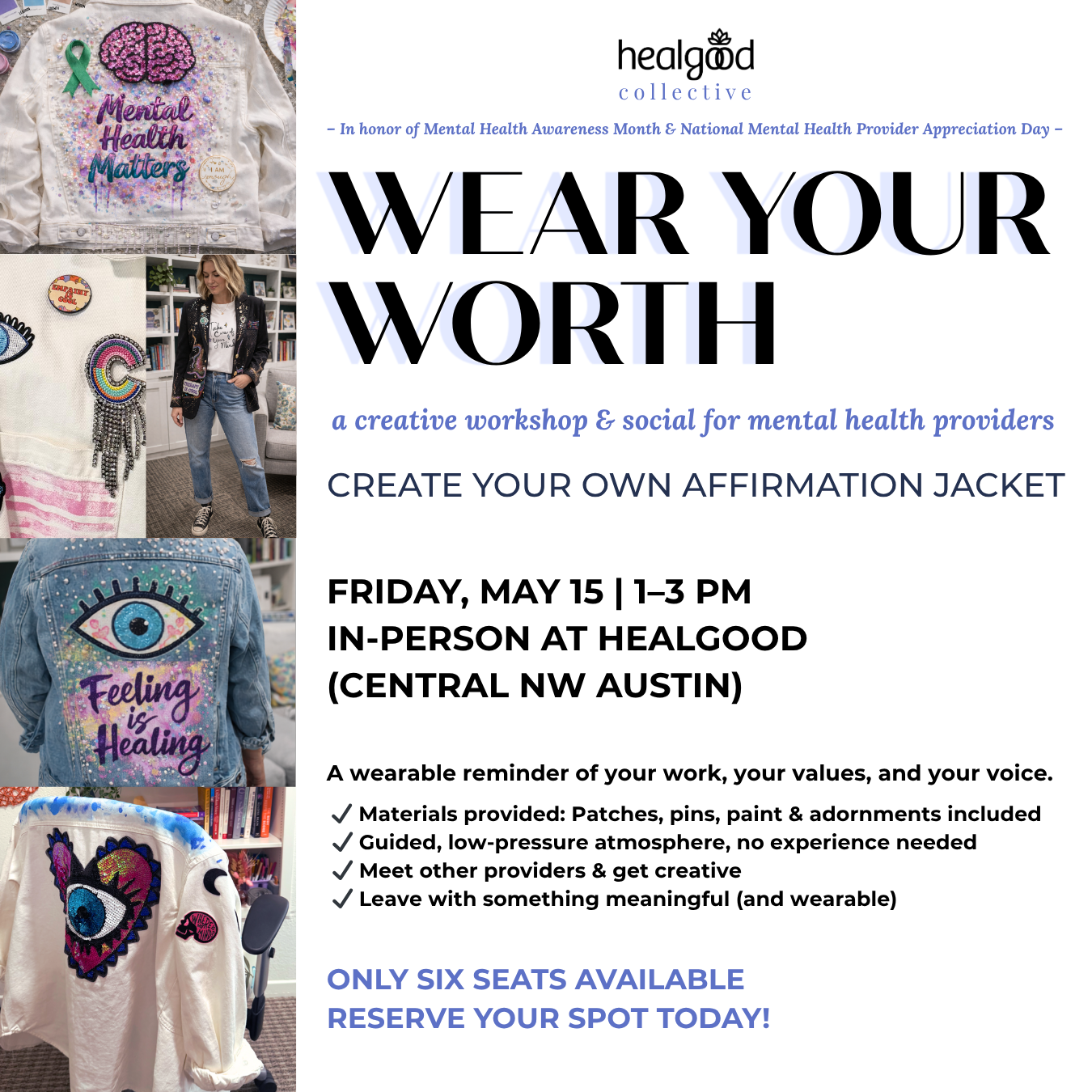
Workshop Overview
In a field that asks so much of us, it can be easy to forget that we are worthy of care, creativity, and celebration too.
In honor of Mental Health Awareness Month (May) and National Mental Health Provider Appreciation Day (May 12), we invite you into a different kind of gathering—one that centers joy, expression, and connection.
Wear Your Worth is a small, intentionally curated Healgood Collective Social Workshop where providers will connect and have fun creating their own affirmation jacket—a wearable piece of art designed to reflect identity, values, resilience, and meaning.
You’ve heard of affirmation cards.
This is something you can wear—an expression of your values, your voice, and your work.
Through patches, pins, paint, and creative adornment, you’ll design a jacket that serves as a tangible reminder of your work, your worth, and your story.
No artistic experience needed—just curiosity and a willingness to play.
Workshop Details
Date: Friday, May 15
Time: 1:00–3:00 PM
Location: Healgood Office
Capacity: Limited to 6 participants
This is a small, intentionally intimate group designed to support connection, creativity, and spaciousness.
What to Expect
A guided, low-pressure creative experience
Time for reflection and intention-setting
Connection with fellow providers in a small-group setting
A finished (or in-progress) affirmation jacket to take home
We’ll Provide
A curated assortment of materials to choose from. Each participant will select:
1 large patch (iron-on or glue-on; approx. 6–8+ inches)
3 medium patches (iron-on or glue-on; approx. 1.5–3 inches)
3 small patches (iron-on or glue-on; approx. 0.5–1 inch)
1 enameled pin (e.g., “Mental Health Matters”)
1 brooch or decorative pin
You’ll also have access to a variety of creative materials, including:
Fabric paints, stencils, brushes, sponges, and more
Mixed adornments (ribbon, buttons, beads, charms, fabric accents, embellishments)
Tools and supplies for application
Light refreshments will be provided.
You Bring
Your own jacket (denim, canvas, or similar recommended—something sturdy enough to support patches and adornments and compatible with iron-on or fabric glue application).
We encourage you to bring a jacket you already own or thrifting one for sustainability and creativity.
Hosted by
Chelsea Fielder-Jenks, LPC-S, CEDS-C, PMH-C & Bernadette Chavez Piñon, LPC, SEP
Registration
$115 — Supported
Covers basic workshop materials and light refreshments | Limited Availability$125 — Sustainer
Reflects the full cost of supplies, space, and facilitation$135 — Pay-It-Forward
Helps make it possible for others to attend at the Supported level while supporting Healgood’s community offerings
We offer tiered, equity-based pricing to support both accessibility and sustainability. Your registration includes all materials and contributes to the continuation of future community offerings.
Spots are limited and tend to fill quickly.
Important Event Information
Limited to 6 participants to preserve an intimate experience
No refunds (registration may be transferred if needed; please contact us)
Event will begin promptly at the scheduled start time
Materials are provided; additional customization items are welcome
Optional Community Donation Drive
In honor of Mental Health Awareness Month and Therapist Appreciation, we’re also hosting an optional donation drive in support of Dress for Success Austin, which provides professional attire and resources for women entering or re-entering the workforce.
If you feel called, you’re welcome to bring gently used or like-new women’s professional clothing and accessories to contribute.
Accepted items include:
Women’s professional clothing (suits, blazers, dresses, shoes)
Handbags and jewelry
Unused toiletries or cosmetics
Guidelines:
Items should be clean, workplace-ready, and in like-new condition
Styles should be current (generally within the last ~5 years)
Please bring items on hangers if possible
Drop-Off Options:
Bring donations with you to the event
Or drop items in the designated bin in our lobby
We’ll collect and deliver all donations following the event.
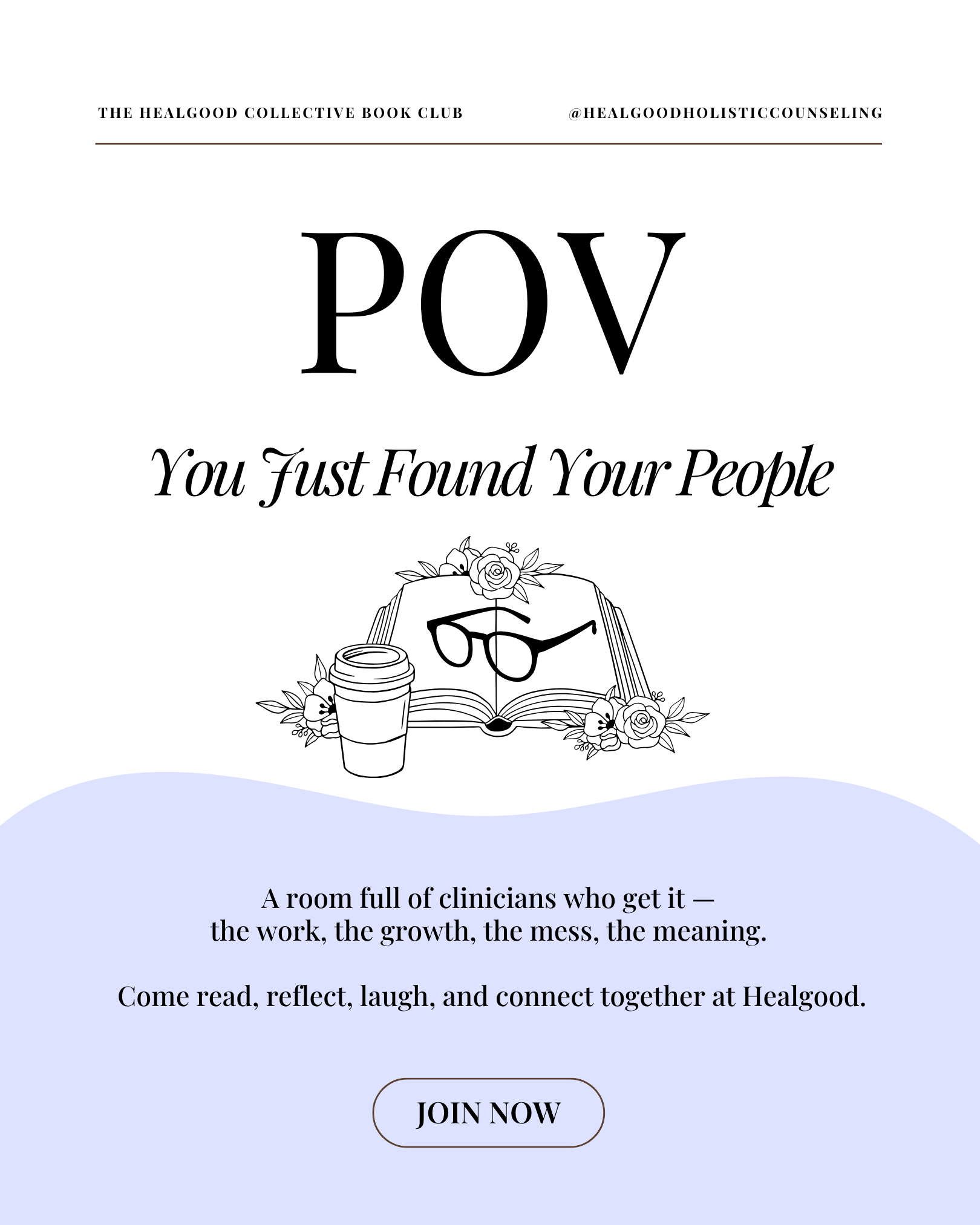
Unmasking Autism
by Dr. Devon Price
6 Distinct Population CEUs Available
Continuing education doesn't have to feel rushed, transactional, or isolating.
Join therapists, dietitians, physicians, psychiatrists, psychologists, and other helping professionals for four thoughtful discussions of Unmasking Autism by Devon Price. Together, we'll deepen our understanding of neurodiversity while earning 6 Distinct Population CEUs in a learning experience designed to foster reflection, connection, and meaningful conversation.
This four-part fall book club invites helping professionals into a thoughtful exploration of Unmasking Autism — a book that has been regarded as a powerful and paradigm-shifting examination of autism, identity, masking, and liberation.
Whether you read every chapter, skim sections, or mostly come to listen and reflect, there is no "right" way to participate here.
Led by Healgood Collective, this group is designed to be warm, spacious, and clinician-centered. You're welcome to share your thoughts, ask questions, or simply be present.
Bring your lunch, settle in, and come as you are.
Why This Book?
Many helping professionals are seeking a deeper, more nuanced understanding of autism beyond outdated stereotypes and deficit-based frameworks.
Unmasking Autism offers an accessible yet deeply meaningful exploration of:
Masking and camouflaging
Neurodivergent identity development
Misdiagnosis and systemic barriers
Intersectionality and marginalized autistic experiences
Authenticity, self-understanding, and liberation
This book club creates a grounded structure for helping professionals to engage with these ideas thoughtfully while connecting with peers in meaningful conversation.
It's an opportunity to deepen both professional understanding and personal reflection, as well as build community with other clinicians.
Why Join?
More than a book club, this is a professional learning community.
Some of the most meaningful learning happens through thoughtful conversation with colleagues from different backgrounds and disciplines. Whether you're looking to deepen your understanding of neurodiversity, reconnect with the joy of learning alongside peers, or simply earn your Distinct Population CEUs in a more engaging way, this series is designed to support both your professional growth and your sense of connection.
About the Book
Unmasking Autism challenges conventional narratives around autism and offers a compassionate reframe that centers lived experience, diversity, and authentic selfhood.
Dr. Devon Price weaves research, personal narrative, and practical insight to help readers better understand autistic experiences—particularly among those historically overlooked, misdiagnosed, or pressured to conform.
This book is especially relevant for professionals seeking to expand neurodiversity-affirming practice.
How the Group Works
The book will be explored over four monthly meetings from September through December.
Each meeting is guided by a thoughtfully designed one-page (front and back) discussion handout that highlights key concepts, learning objectives, reflective questions, and opportunities for clinical application. The handout serves as a roadmap for our conversation while leaving plenty of room for curiosity, connection, and the unique perspectives participants bring to the group.
You are welcome to:
Join even if you didn't complete all the reading
Read at your own pace
Listen, share, or participate in whatever way feels supportive
Engage with both personal reflection and professional application
We encourage participants to commit to the full series, as conversation and connection naturally deepen over time.
There's No "Right" Way to Participate
Read every page. Skim the chapters. Bring notes. Bring questions. Come mostly to listen.
However you choose to engage, you're welcome here.
What You'll Leave With
By the end of the series, participants will have:
A deeper understanding of autism beyond traditional stereotypes and deficit-based models
Greater confidence applying neurodiversity-affirming concepts in professional practice
Practical ideas for supporting autistic individuals with greater curiosity and compassion
New perspectives gained through interdisciplinary discussion
Meaningful professional connections with fellow helping professionals
Up to 6 Distinct Population CEUs
Continuing Education
Up to 6 Distinct Population CEUs Included
This series includes 1.5 Distinct Population CEUs per meeting (6 total CEUs) built directly into registration.
Participants who complete all continuing education requirements may earn CE credit at no additional cost.
CE Requirements
To receive 1.5 CE credit for each session, participants must:
Attend the full live meeting (1.5 hours)
Complete a post-session evaluation that includes a short reflection and content check related to the assigned reading
CE credit cannot be awarded for attendance alone, and no partial CEUs will be granted.
Continuing Education Information
This program is designed to meet Texas BHEC Distinct Populations continuing education requirements for LPCs and LMFTs, including the 50% rule for hours obtained through approved providers.
For Texas Social Work and Psychology licensees, these offerings may be counted toward continuing education requirements as non-approved provider hours (the remaining 50%), in accordance with board guidelines. We’ve designed these trainings with licensure requirements in mind; however, requirements can vary and evolve. As with all continuing education activities, final responsibility for license compliance remains with the participant.
Schedule
First Fridays | 1:00–2:30 PM
September through December
Location: Central NW Austin, 78731 (address to be emailed prior to first meeting)
September
Meet the group
Set intentions
Explore the Introduction + Chapter 1
October
Chapters 2–4
November
Chapters 5–7
December
Chapters 8–Conclusion
Final reflections
Integration
Closing discussion
Registration & Pricing
Full Series Registration: $200 ($50 per session)*
Includes:
Four facilitated discussions
Light refreshments
Up to 6 Distinct Population CEUs
Space is intentionally limited to preserve the warmth, connection, and meaningful discussion that make this experience unique.
*If cost is a barrier, please don't hesitate to reach out. Accessibility matters to us, and we're happy to discuss options whenever possible.
Who This Is For
This series may be especially meaningful for:
Therapists
Psychologists
Dietitians
Physicians
Psychiatrists
Nurses
Occupational therapists
Speech-language pathologists
Clinical supervisors
Graduate students and trainees
Neurodiversity-affirming clinicians
Helping professionals seeking a deeper understanding of autism, masking, identity, and neurodiversity-affirming care
Frequently Asked Questions
Do I need to finish the reading before each meeting?
While we encourage participants to read as much as they're able, we understand that life, work, and competing demands can sometimes get in the way. You're welcome to join regardless of how much you've read. Many participants find that some of the richest learning comes from listening, reflecting, and engaging in conversation with the group.
Is this only for therapists?
Not at all. We welcome professionals from a variety of disciplines who support neurodivergent individuals. Interdisciplinary conversation is one of the greatest strengths of the group.
Do I need experience working with autistic clients?
No. This series welcomes both professionals who are newer to neurodiversity-affirming practice and those with extensive experience.
Will I receive a Certificate of Completion?
Yes. Participants who successfully complete the continuing education requirements for each session will receive a Certificate of Completion documenting 1.5 Distinct Population CE hours earned for that meeting. This program is designed to meet Texas BHEC Distinct Populations continuing education requirements for LPCs and LMFTs. Participants who complete all four meetings may receive certificates documenting a total of 6 Distinct Population CE hours. Licensed professionals from other disciplines are responsible for verifying applicability with their individual licensing board.
A Note About Our Learning Community
This series is designed to be thoughtful, relational, and engaging.
You don't need to be an autism expert or have all the answers. Curiosity, openness, and a willingness to learn alongside others are enough.
Whether you come ready to discuss every chapter or simply listen and reflect, your presence matters.
Come as you are.
Questions? Please contact us — we’re happy to help!
References
Barlow, C. A., & Phelan, A. M. (2007). Peer collaboration: A model to support counsellor self-care. Canadian Journal of Counselling, 41(1), 3–15. pdf download
Barnett, J. E., & Cooper, N. (2009). Creating a culture of self-care. Clinical Psychology: Science and Practice, 16(1), 16–20. https://doi.org/10.1111/j.1468-2850.2009.01138.x
Posluns, K., & Gall, T. L. (2020). Dear mental health practitioners, take care of yourselves: A literature review on self-care. International Journal for the Advancement of Counselling, 42(1), 1–20. https://doi.org/10.1007/s10447-019-09382-w