
Why Summer Can Actually Be Hard on Mental Health (And Five Small Strategies That Can Help)

When people think of summer, they often picture vacations, sunshine, pool days, and carefree afternoons. While those moments certainly exist, many people are surprised to find that summer can also bring increased stress, anxiety, loneliness, or emotional overwhelm.
If you've found yourself feeling "off" this season, you're not alone, and you're certainly not doing summer wrong.
Mental health doesn't take a vacation just because the weather gets warmer.
Why Summer Can Feel More Difficult Than Expected
1. Routines Suddenly Disappear
School schedules end. Work schedules may change. Vacations interrupt normal rhythms. Kids are home. Sleep habits shift.
While a break from routine can feel exciting at first, our brains and nervous systems often benefit from daily structure and predictability. Even positive changes can create stress because they require us to constantly adapt.
For many people, summer means making hundreds of additional decisions every week — from childcare arrangements to travel plans to simply figuring out what everyone is doing each day. That extra mental load can quietly contribute to exhaustion.
2. More Social Pressure
Summer often comes with an unspoken expectation that we “should be having fun.”
Social media fills with vacations, family gatherings, weddings, beach trips, and smiling group photos. It's easy to compare your “behind-the-scenes life” to everyone else's “highlight reel.”
If your summer doesn't look like the one you imagined (or the one you see online) you may find yourself feeling disappointed, isolated, or like you're somehow falling behind.
3. Body Image Can Become Louder
Warmer weather often means more conversations about swimsuits, vacations, appearance, dieting, or "getting summer ready."
For individuals navigating eating disorders, disordered eating, body image concerns, or recovery, these messages can become especially overwhelming.
Remember: your body does not need to earn the right to enjoy summer. Every body deserves nourishment, rest, movement that feels good, and meaningful experiences.
4. Parents Are Carrying a Different Mental Load
Summer can be wonderful… and incredibly demanding.
Parents often find themselves balancing work, childcare, camps, meals, transportation, activities, and the desire or pressure to create memorable experiences for their children.
If you're feeling stretched thin, it doesn't mean you're doing something wrong. It means you're managing a lot.
Children don't need perfect summers. They benefit most from feeling safe, connected, and loved.
5. Big Life Transitions Often Happen in Summer
Common examples:
Graduations.
Moves.
New jobs.
Weddings.
College.
Relationship changes.
Pregnancies or child birth.
Losses.
Even exciting transitions bring uncertainty. Our brains often interpret uncertainty as stress, regardless of whether the change is positive or difficult.
Feeling emotional during periods of transition is a normal human response.
Five Small Strategies That Can Make Summer Feel More Manageable
You don't need to overhaul your life to care for your mental health. Sometimes small, intentional practices create meaningful change.
1. Build a "Flexible Routine"
Instead of trying to recreate your school-year schedule, choose just three daily anchors.
For example:
Wake up around the same time
Eat regular meals throughout the day
Spend 10 minutes outside
A few predictable touchpoints can help your nervous system feel more grounded while still allowing space for spontaneity.
2. Practice "One-Mindfully"
Summer often feels busy because we're mentally juggling ten things at once. DBT (short for Dialectical Behavior Therapy, a modality we practice at Healgood) encourages us to practice One-Mindfully — giving our full attention to one activity at a time.
When you're eating, just eat.
When you're swimming with your kids, just swim.
When you're watching a sunset, let yourself actually notice it.
Being fully present doesn't eliminate stress, but it often reduces the feeling of constantly being pulled in multiple directions.
3. Check-the-Facts
Our minds are excellent storytellers. Maybe you notice yourself thinking:
"Everyone else is having a better summer."
"I'm failing as a parent."
"I should be doing more."
"I've wasted my vacation."
Before accepting those thoughts as facts, pause and ask:
What evidence supports this?
What evidence doesn't?
Is there another balanced way to view this situation?
Checking-the-facts (another DBT skill) isn't about forced positivity — it's about helping our emotions match reality rather than assumptions.
4. PLEASE Your Body
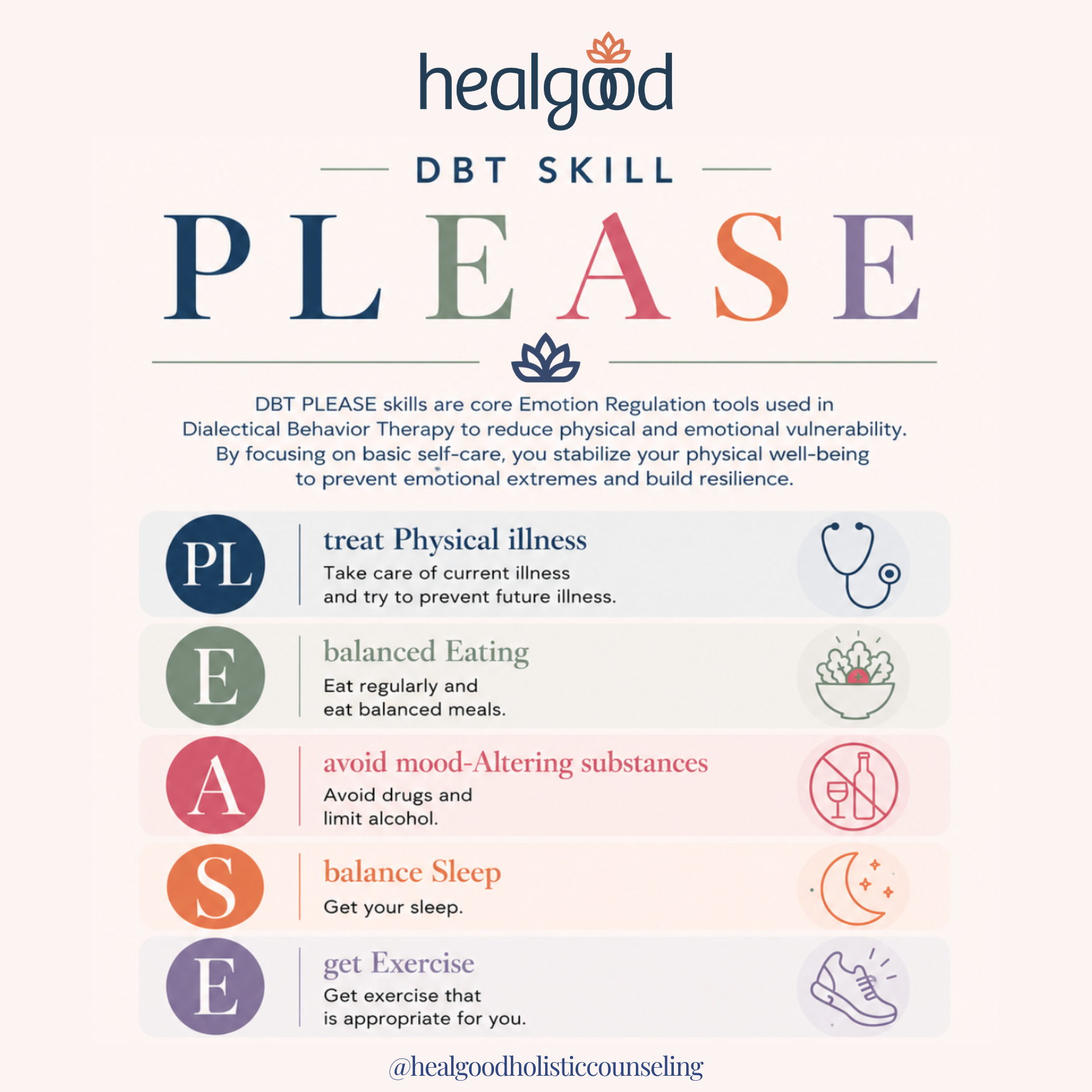
These skills aren't about perfection—they're about giving your mind and body the support they need to navigate life's inevitable stressors.
If your emotions have felt "bigger" lately, start with the basics. Sometimes the most compassionate thing we can do is care for our bodies first.
Have you ever noticed that everything feels harder when you're sick, exhausted, hungry, or running on empty?
That's not a personal failing—it's part of being human.
One of the core Emotion Regulation skills in DBT is PLEASE, a reminder that caring for your physical health can help reduce emotional vulnerability and strengthen resilience.
Summer is a wonderful time to gently check in with yourself:
Am I eating enough?
Am I staying hydrated?
Am I getting enough sleep?
Am I moving my body in ways that feel enjoyable?
Am I taking medications as prescribed? Abstaining from mood-altering substances?
Small acts of physical care can have a surprisingly powerful impact on emotional resilience.
5. Create Moments That Feel Like a Life Worth Living
One of our favorite DBT notions is building a "Life Worth Living." That doesn't require expensive vacations or elaborate plans.
It might look like:
Reading outside with your morning coffee.
Taking an evening walk.
Watching lightning bugs with your kids.
Calling an old friend.
Listening to your favorite music while driving with the windows down.
Visiting a local farmer's market.
Trying a new recipe.
These moments may seem ordinary, but over time they become the building blocks of a meaningful life.
A Gentle Reminder
Looking for support?
Our therapists provide individual therapy for children (10+), adolescents, adults, couples, and families throughout Texas via secure telehealth, with in-person appointments available in the Austin area. We also offer groups and workshops designed to help individuals build practical skills, meaningful connection, and lives worth living.
If you're ready to take the next step, we'd be honored to walk alongside you.
If summer has been harder than you expected, there's nothing wrong with you.
Life doesn't become emotionally effortless simply because the calendar says June or July.
Whether you're navigating anxiety, depression, grief, burnout, relationship challenges, parenting stress, eating disorder recovery, or simply feeling overwhelmed by life's transitions, support is available.
At Healgood, we believe healing isn't about having perfect circumstances. It's about building the skills, support, and self-compassion needed to navigate whatever season you're in.
Because mental health matters every season — not just the difficult ones.